
Hyperliquid vs GMX: Fees, Funding & Liquidation, Side By Side
I wanted a straight answer on which one costs less, Hyperliquid or GMX. The docs can't give you one without your actual trade, so here's how each one charges you, handles funding and liquidates you.

If you’re trading perps on a DEX, sooner or later you’ll ask which one is cheaper, Hyperliquid or GMX, because those fees can slowly eat into your profits.
I wanted a clean answer, so upon checking some docs on both platforms, it turns out the published rules don't give you one, not without knowing the trade, the market, your fee tier, and how long you sit in the position.
So I went through both sets of docs piece by piece with the help of ChatGPT: what each one charges you, how funding works, and what actually gets you liquidated.
Nobody likes liquidation, and I do mean nobody. Everything listed here comes from the protocols' own docs, checked on October 6, 2026.
Hyperliquid numbers use its base fee tier.
GMX says most markets use its standard position fees, but fees and risk settings can vary by market and chain, so the live order ticket is always the final word for a specific trade.
If you want the longer story on Hyperliquid itself, I wrote Hyperliquid explained a few weeks back. This post is educational; it's not an invitation to trade on either venue, and it's not financial advice. Kindly conduct your own due diligence.
The Quick Version
- Trading fee. Hyperliquid's base tier is 0.045% taker or 0.015% maker per executed trade, lower at higher 14-day volume tiers. On most markets, GMX charges 0.04% or 0.06% of position size every time you open, close, increase, or partially decrease, depending on whether your action reduces or increases the long/short open-interest imbalance.
- Funding. Hyperliquid pays it hourly between longs and shorts, based on a premium index plus a fixed interest component. GMX accrues it continuously, per second, and the rate adapts to the long/short open-interest imbalance. On GMX, you can pay funding or receive it.
- Other holding cost. GMX adds a separate borrow fee based on how much of the pool you use. Hyperliquid's standard perp funding has no equivalent borrow fee.
- Liquidation. On Hyperliquid, it's your account equity falling below maintenance margin, and cross and isolated margin use different collateral pools. On GMX, it's your remaining collateral, after losses and accrued fees (including capped negative price impact), falling below the market's minimum collateral threshold.
What You Pay To Open & Close
Hyperliquid's fee schedule has a base perps rate of 0.045% taker and 0.015% maker. It moves with your rolling 14-day weighted volume, and spot volume counts double toward that tier.
At qualifying maker-volume tiers, maker fees can turn into rebates. So the base tier is where you start, not necessarily what you pay.
There's one extra on Hyperliquid. If you trade through a third-party front end that uses a builder code, that builder can take a fee on your fills, up to 0.1% on perps, and you have to approve the maximum first.
GMX's fee docs list 0.04% when your action reduces the absolute long/short open-interest imbalance and 0.06% when it increases it. That applies to opening, closing, increasing, and partially decreasing a position.
GMX can also charge swap fees, price impact, and network fees in some cases, so the position fee alone isn't the whole bill.
A $10,000 Round Trip
Say you open a $10,000 position and close it at the same $10,000, no size changes in between.
- Hyperliquid, base taker rate: $4.50 to open and $4.50 to close, so $9 in trading fees. As a maker at the base rate, it's $3 total, before any rebate.
- GMX: $4 to $6 in position fees on each $10,000 operation, so $8 to $12 for the open and the close.
Please don't read that as one venue being cheaper overall. It leaves out funding, GMX network fees, any swap fee, price impact, Hyperliquid builder fees, and any difference between the price you see and the price you actually get filled at.
A partial close or a size change also changes what later fees get charged on. On GMX, every order is a request that a keeper executes.
The network fee you see covers the keeper's gas, and the unused part of that estimate is refunded after execution.
Funding Runs On Different Clocks
On Hyperliquid, funding is paid every hour. The docs compute an eight-hour rate from the average premium index plus a clamped interest-rate adjustment, then pay one eighth of it each hour.
The premium is sampled every five seconds and averaged over the hour. A positive rate means longs pay shorts, a negative one means shorts pay longs. It's peer-to-peer; the protocol collects no fee on those payments, and it's capped at 4% per hour. It's all laid out in Hyperliquid's funding docs.
GMX funding accrues continuously, using per-second math. The rate adapts to the long/short open-interest imbalance; a positive rate means longs pay shorts, and a negative one means shorts pay longs. A sudden swing in the imbalance doesn't necessarily flip who pays right away, because the saved rate adjusts over time.
Funding settles when you modify or close the position, not at a fixed hourly time. On Arbitrum, GMX reads funding rates from external venues to update market funding ceilings, while GMX's own open-interest imbalance drives the rate you actually pay or receive.
Settings differ by market and chain.
GMX documents adaptive funding and settlement on its fees page. GMX also charges a borrow fee, separate from funding. It accrues continuously on open positions, and only the side with the larger open interest pays it. The rate changes with pool utilization, and the trading screen shows it as a percentage per hour.
Hyperliquid's standard perp funding page doesn't list a borrow fee like that, though its portfolio margin mode does charge interest on borrowed assets. So the account mode you're in matters too.
One funding snapshot won't tell you which position is cheaper to hold. Rates move while you're in the trade, and the direction can differ by asset and by hour. If you're comparing, compare the live rate for the same market over the same holding time.
Liquidation
Hyperliquid's maintenance margin is half the initial margin at the asset's maximum leverage. Max leverage varies by asset, so the docs put maintenance anywhere from 1.25% for 40x assets to about 16.7% for assets capped at 3x. Cross positions share your account collateral; isolated ones use only the margin you gave that position.
Liquidations use the mark price. Hyperliquid first tries to close you out with market orders on the book. If that doesn't restore the requirement and your equity drops below two-thirds of maintenance margin, the liquidator vault can step in as a backstop. Book liquidations have no clearance fee, but in a backstop liquidation you don't get the maintenance margin back. Hyperliquid's liquidation docs walk through the whole process.
GMX checks whether your remaining collateral, after unrealized losses, accrued fees, and capped negative price impact, is still above the market's minimum collateral threshold. The docs put that threshold between 0.25% and 1% of position size depending on configuration, plus an absolute minimum collateral floor that can matter more on small positions.
The liquidation fee is separate: 0.20% to 0.45% of notional depending on market type, taken when the position is actually closed and not counted in the check itself.
Whatever collateral is left after losses and fees goes back to your wallet, per GMX's liquidation docs.
Those percentages don't measure the same thing, so please don't line up 1.25% against 0.25% and decide which one liquidates you sooner.
Entry price, collateral, position size, your other cross-margin positions, accrued costs, and each protocol's price inputs all move the line, so be aware.
I've been liquidated many times before, and it sucks every time; there’s nothing enjoyable about it. If you want to see where that line sits before you click, our free leverage calculator draws it for you, so you get a visual.
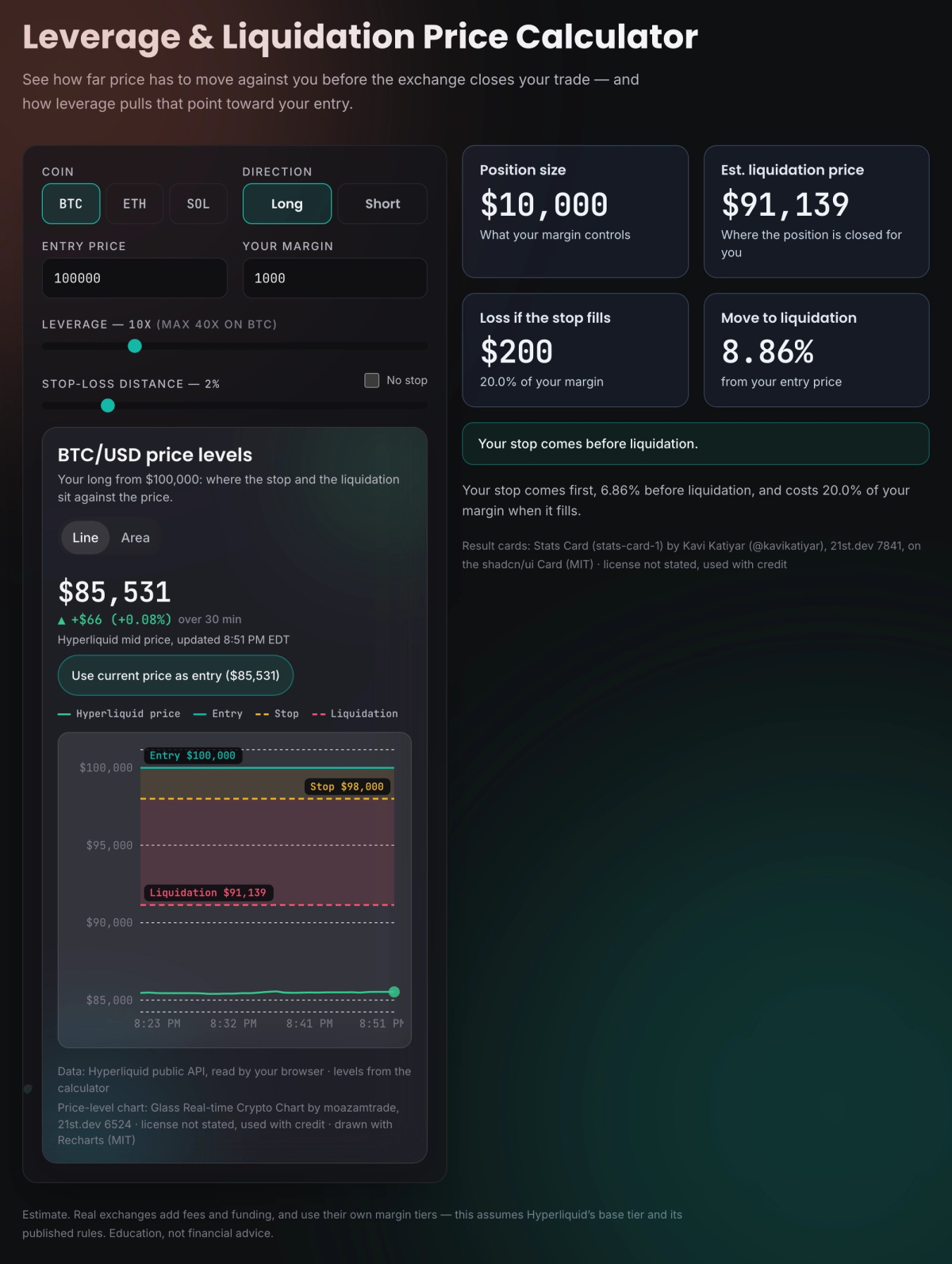
Our leverage calculator defaults to 10x BTC long. It's an estimate built on Hyperliquid's base tier and published rules, so it shows Hyperliquid's liquidation math, not GMX's, so keep that in mind.
Where The Costs Actually Show Up
The fee math above is per trade. The easy-to-miss part is how it adds up, because fees and funding come out in small pieces, and if you only look at entries and exits, you never see the total.
That's why the TechMalak Dashboard splits each symbol into what the trades made before fees and funding and what you actually kept after.
Here's what that looks like on a sample account.
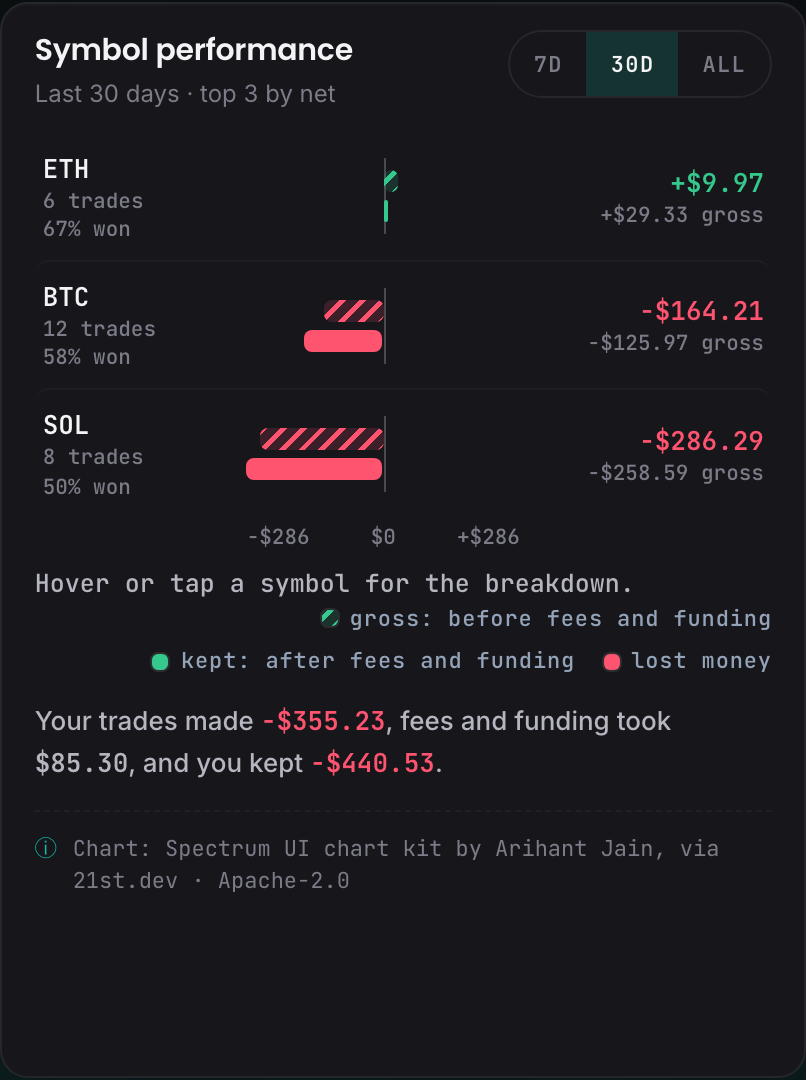
Sample account, test data, not a real trader. TechMalak Dashboard, Symbol performance: striped bars are before fees and funding, solid bars are what was kept after.
Which One Is Cheaper?
At base rates, a same-size $10,000 open-and-close costs $9 in taker fees ($3 as maker) on Hyperliquid and $8–$12 in position fees on GMX, before funding, borrow, network, swap, and price-impact costs.
That's a narrow fee calculation, not an all-in ranking. For a real comparison, the inputs have to match: same asset, direction, notional, collateral, holding period, order type, market conditions, and account settings.
Then you add the live funding and borrow rates, the trading and network fees that apply, and execution impact.
Without all that, calling one of them "cheaper" or "safer" is more than the docs can tell you. Anyway, rates and settings change, so check the live numbers before you size anything, and remember this isn't financial advice.
TechMalak is in open beta, free, no credit card, and it reads your Hyperliquid, GMX, and Bitget trades read-only. If you trade perps on either, I'd like to hear what you want to compare next. Back at it tomorrow.