
Hyperliquid Explained, And Why I Added It to TechMalak
I've traded on exchanges where access changed for Canadian traders after regulation enforcement. That experience left a bad taste in my mouth and ultimately drew me toward DEXs, which is part of the reason why I wanted Hyperliquid support on TechMalak.

Over the years, I’ve traded on platforms that later stopped serving Canadian traders, and others where the products I wanted became restricted, such as Coinbase and Kraken, both of which are still among my favorite exchanges. After one bad experience after another, I said to myself, something has got to give; there must be a better way.
That experience led me toward decentralized exchanges. At first, I was skeptical because I’d never used one before, and I wasn’t sure of the workflow. I saw YouTube videos of other traders using various platforms, so I decided to try a few.
After some trial and error, I quickly got hooked on DEXs, and it became clear why they are popular, albeit to a small fraction of the crypto community. They are easy to connect, no KYC, and readily available to users around the world.
Fast-forward a few years later, and it’s HyperLiquid that is dominating the headlines, with respect to perps-dex trading. The sheer amount of user’s and the staggering trading volume, makes this exchange hard to ignore.
Why it caught my attention
The changes to exchange access have been personal for me because I love crypto and the underlying ethos of the OG’s in the community, that stick-it to the man attitude.
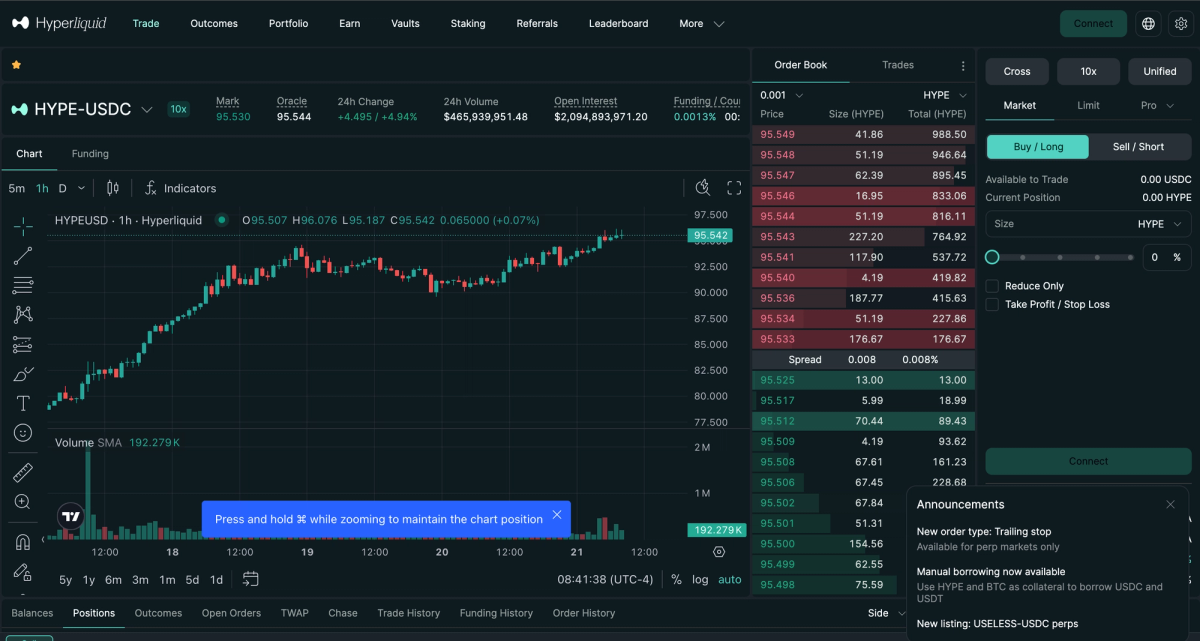
When I trade on any platform, one of the key things that attracts me as a user, is the interface. Clean, simple, and straight to the point is how I like my dashboards. Trading interfaces can get complicated because they have to display raw data in a user-friendly format. So when I’m using HL, I appreciate how everything is layed out, and that’s a big win in my books.
Simple interfaces should include your chart with charting tools, order books, a favorites tab, and the trade execution panel, all of which HL includes.
To be honest, the biggest reason why I like trading on DEXs is because of the strict regulatory environment in Canada towards CEXs. I’m basically left with few options, just like many of you who live in the USA.
I was almost forced down this road, but I am glad I went this way to be honest. The freedom and the simplicity of Decentralized exchanges are amazing in my opinion.
So when I talk about preferring DEX integrations, that comes from my experience as a Canadian trader and crypto enthusiast who feels like he’s been pigeonholed into a corner with little space.
There's a distinction worth keeping straight, though. An exchange leaving Canada and an exchange restricting derivatives aren't the same thing. Coinbase still serves Canadian customers, while its Canadian derivatives offering has separate eligibility requirements.
Kraken's current support documentation says Canadian residents cannot trade margin or derivatives. Those are the published positions checked on September 15, 2026. Coinbase eligibility, Kraken restriction, and it doesn’t look like anything will change soon.
Hyperliquid has its own restrictions, too, which I'll get into below.
For TechMalak, the useful part is straightforward. You can bring in your Hyperliquid history using your public wallet address. You don't have to create an exchange API key or give the journal permission to trade, we’re stricly read-only around here.
From a development point of view, it’s a little easier to work with because you don’t have to worry about API changes that can break things.
What is Hyperliquid Anyway?
Hyperliquid is a blockchain with an exchange built into it. You can trade spot assets and perpetual futures through its onchain order books. The trading component is called HyperCore; HyperEVM supports other applications on the same network. Hyperliquid's overview
If you've used an order book before, the basic idea is familiar: buy and sell orders meet at different prices.
Spot trading exchanges the assets themselves. A perpetual futures position gives you exposure to price changes through a contract without a scheduled expiry. Hyperliquid's introduction
That distinction matters when you review your trades. Holding a perp introduces funding payments and margin requirements that you don't get from simply buying a spot asset.
Who started it, and When?
Hyperliquid Labs is led by Jeff Yan and the pseudonymous iliensinc. The official contributor page identifies them as Harvard classmates and says the team is self-funded, without external capital. Jeff's full name is also documented in reporting about the founders. Official contributor page, Forbes founder profile
The team's own July 2023 update gives a useful timeline:
- September 2022 — Development of the order-book perpetual futures exchange began.
- November 2022 — An Arbitrum Goerl
- i testnet opened with a paper-trading competition.
- December 2022 — The Hyperliquid L1 testnet went live.
- February 2023 — Mainnet entered closed alpha with an initial group of testers.
Those dates describe development and the initial exchange rollout. They aren't a token-launch date. Hyperliquid's July 5, 2023 update
How much trading happens there?
You need the timeframe beside the number. A day's trading volume measures activity during that window. Cumulative volume adds up trading over the source's recorded history. Neither tells you how much traders made.
Draft data snapshot, retrieved September 15, 2026: the accessible DefiLlama pages displayed the following USD figures. These are retrieved page snapshots, not a verified synchronized live reading; the spot page was indexed earlier than the perp page. Refresh both together before publication.
- Perpetual futures: Displayed 24-hour volume $4.245 billion · Displayed cumulative volume $5.286 trillion · Source DefiLlama perpetual volume
- Spot / DEX: Displayed 24-hour volume $124.39 million · Displayed cumulative volume $165.387 billion · Source DefiLlama DEX volume
I wouldn't use those two snapshots to calculate a spot-versus-perp market share. For your own execution, you also need to look at the spread and available orders in the specific market you're trading. An exchange-wide total won't tell you the price your order will get. Bottom line, Hyperliquid is very liquid, no two ways about it.
Can you use Hyperliquid in Canada or the US?
As of September 15, 2026, independent publication Hyperliquid Academy reports that Hyperliquid's terms identify the United States and Ontario, Canada, among restricted jurisdictions.
That is a restriction naming Ontario, not a blanket statement that Hyperliquid “geoblocks Canada.” Hyperliquid Academy's country review
We couldn't retrieve readable text from the primary terms page for this draft, so that wording remains attributed to the secondary source. Check the current Hyperliquid terms for the rules that apply to you.
Could Hyperliquid come to the US?
Possibly, depending on the regulatory path. On August 19, 2026, The Block reported that President Trump said the CFTC was working to bring Hyperliquid into the US in a compliant and legal way. Separately, the independent Hyperliquid Policy Center is advocating for rules that would allow Americans to access onchain markets. The Block's report, Hyperliquid Policy Center
As far as we know, very important people in government are working towards a path to clear regulation. I only hope there’s no barrier to access, like having a certain net worth, or some other bogus criteria.
What does it cost to trade?
Hyperliquid's published base tier lists perpetual trading fees of 0.045% taker and 0.015% maker. The spot base tier lists 0.070% taker and 0.040% maker. A taker removes available liquidity; a maker adds a resting order that gets filled.
Your actual rate can change with your volume tier, discounts, the market, and any additional applicable fees. Check the rate shown for your account and market. Funding and slippage also affect what a trade costs, beyond the execution fee.
How does funding work?
Funding is a payment between the long and short sides of a perpetual market. On Hyperliquid, it settles hourly. Positive funding means longs pay shorts; negative funding reverses that direction. The rate can change while your position stays open. Official funding documentation
If you only review your entry and exit prices, you're missing part of the result. Funding belongs in that review as well.
Can you still get liquidated on a DEX?
Yes. On Hyperliquid, liquidation can begin when your account equity falls below the required maintenance margin. Its documentation explains that liquidation uses the mark price, which can differ from the latest order-book price. Cross and isolated positions also have different consequences for the collateral involved. Official liquidation documentation
An interface feeling simpler doesn't make a leveraged position forgiving. I've been liquidated before. That's not something I want you to lose sight of because the platform is easier to use.
How do you add your Hyperliquid wallet to TechMalak?
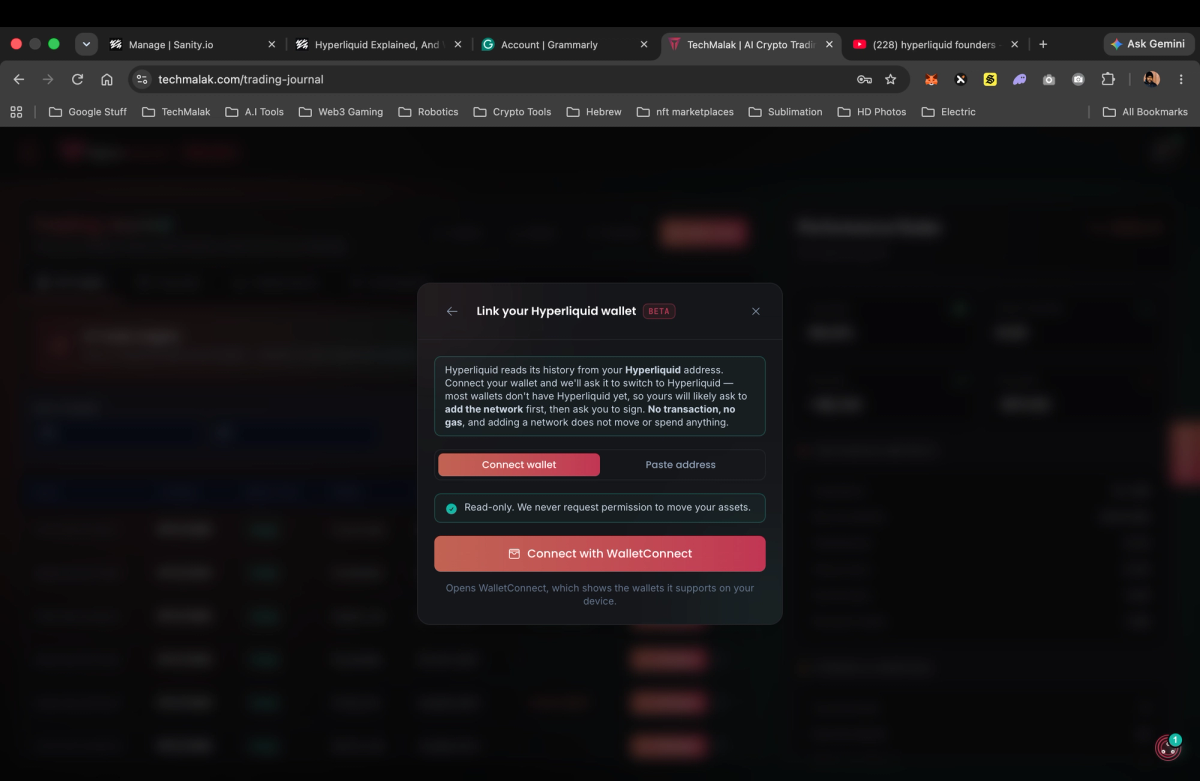
After signing up, you can connect through WalletConnect or paste your public wallet address. Pasting gives you a way to add your history even if you don't have a wallet installed on the device you're using.
For this import, TechMalak reads the public address. You don't provide an API key, trading permission, or withdrawal permission. There is no trading authorization to revoke.
What gets imported?
Your fills come in with the history needed to group them into positions and decisions. That helps you review a trade you built or closed in pieces, instead of treating every execution as an unrelated decision.
Funding is attributed to positions where it can be matched. If funding can't be matched within the import window, it is reported as unattributed rather than silently disappearing. Repeating an import doesn't create duplicate copies of the same fills.
What can you learn from those trades?
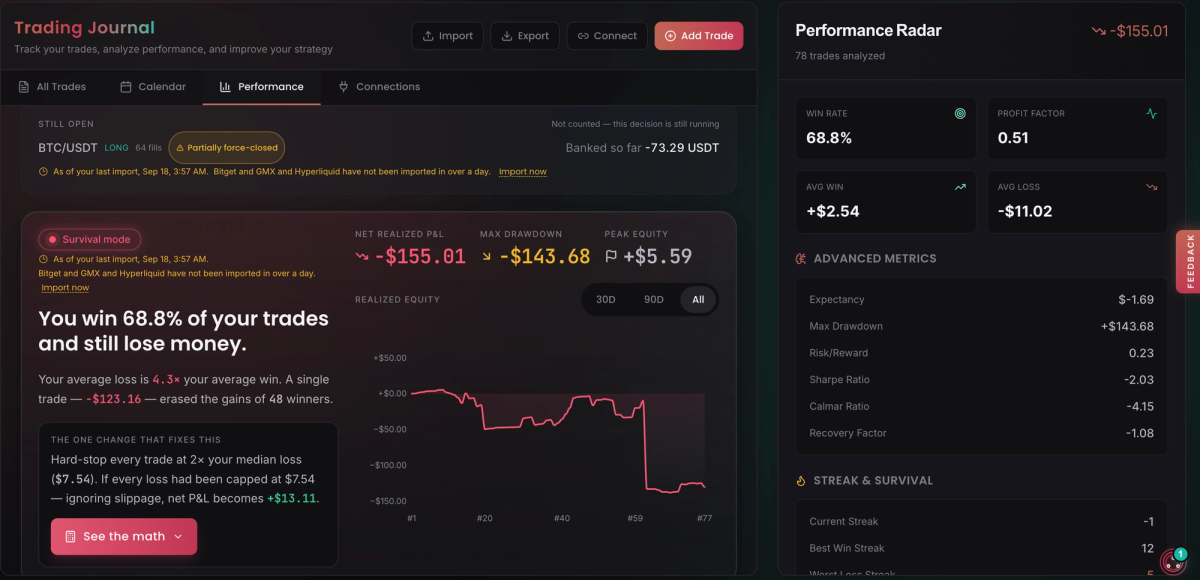
TechMalak puts your costliest detected pattern first, so you have somewhere specific to start reviewing. It looks for revenge entries after painful losses and repeated losing closes where you kept re-entering. The tilt monitor looks for bursts of entries after consecutive losses, compared with your own trading pace.
The calendar helps you look back across your trading days. These are prompts to examine your decisions, not proof of what you were feeling when you clicked. You still bring that context.
That's where Yahsuke fits in, our AI chatbot. He helps you look at the decisions behind your own trades and the patterns that keep costing you. TechMalak is a journal and coach, not a signal service, so he doesn’t give you any.
Hyperliquid doesn’t seem like it’s going anywhere anytime soon. If anything, they are growing, and with interest around the world building for this trading platform, it’s slowly becoming a gold standard in some parts of the community.
As HL expands, you can expect tighter integration between TechMalak and it. As far as DEXs go, the one thing I’d like to see changed is their restrictions on North America. You can make the argument, that if a DEX restricts your usage, then it truly isn’t a DEX in the purest form. As with most things in this space, it’s a wait-and-see situation.